Translate

Thursday, December 5, 2013


Review Survey Submission: Course Evaluation


Content

User
William Johnson
Course
Course Evaluation (FALL 2013) - ART 245.1002 Digital Media I (Whittenberger, Peter)
Survey
Course Evaluation
Started
12/5/13 6:24 PM
Submitted
12/5/13 6:29 PM
Status
Completed
Time Elapsed
4 minutes out of 1 hour.
Instructions

Thursday, December 5, 2013 6:55:31 PM PST


Motel Life Response paper

          This was a semester that came with many surprises for me. I was privileged to be one of the few that were able to see the special viewing of the film Motel Life.

This film was created based on the Novel by Will Vlautin. Will Vlautin has written several novels and is a former student of the University of Nevada, Reno. It seemed appropriate to have the premiere of the film be located on campus. I was not fortunate to be among the few that was involved in the question and answer period after the first showing but I heard it had a very good attendance.

The film was produced by Alan and Gabriel Polsky. The main cast consisted of: Emile Hirsch, Steven Dorff, Dakota Fanning, Joshua Leonard, and Kris Kristofferson. The basis behind the plot is based on two brothers that are down on their luck and stuck in Reno after their mother dies.  Several scenes involve gun stores strip clubs motels and St. Mary’s Hospital, the same hospital I just happened to be born in. It give us a look at the underdogs in life. Those individuals who just scratch out a living day to day finally get center stage.

While writing this paper I find it somewhat difficult not to be a film critic and stick with the genera of media production and digital media outlines. The film was well thought out and I appreciated the fact that I did not read the book first. There were several technical glitches I uncovered in the editing and initial filming. If you do not come from this area you will never know what they are so I will not mention them after all it is Hollywood that we are talking about.

Film as a medium has a long established foot hold when it comes to entertainment. Digital media has been gaining ground in the entertainment Industry for several decades now. It has been blending in but has not been able to fully replace film and I do not feel that it ever will. Creativity is human based and will not be replaced by machines. Technology has the ability to reproduce and manufacture what has been created and in some way allowed the artist to be creative in an unlimited new way. This technology has allowed film makers to continue forward in a new way, using AVATAR as a prime example. This film was a pleasure to watch because there were no technical or special effects created by computers. This is a great example of a script well written with actor who actually now how to act. Go see this film it is worth your time, I just hope it gets the recognition it deserves.


Media Response Fall 2013


                                       Hidden Cave Documentary showing

                  I got the unexpected opportunity to attend the showing of Hidden Cave here on the University of Nevada campus. I was in the overflow group that viewed the film in the Dynamic Media Lab inside the Knowledge Center.

Hidden cave is a documentary of just one of the best archaeological sites within the state of Nevada. The cave was initially created some 23,000 years age from the actions of waves hitting the shoreline from Pleistocene Lake Lahontan as it was rising in its own formation. Over the centuries the site has been flooded and reviled several times. It eventually became a place that could be used for human occupancy. This site has become a prime historical Archaeological record of the American Indians here in Nevada. The local tribes used it as a place of safety for many different reasons.

Now days the use of video, film and digital media has become imperative in recording historical facts. The actions and care taken by the creators of this documentary shows the caring and wisdom needed today in order to keep the process going without creating a negative reaction for the indigenous residents. In the past videographers and research teams would simply storm the door so to speak film and dig and destroy in order to obtain that special shot or in gathering the information they wanted.

Being involved in media production at one part of my life I really appreciate the way in which the program was edited assembled and shown to the public. I especially appreciated the involvement of the researchers and the acceptance of help from the Fallon Paiute-Shoshone Tribe members which were allowed to share their stories about the history of the site. The University of Nevada should be very proud of their efforts, responsibilities in the caring that was taken in the final production and editing of this documentary. Keeping each clip to only about 10 seconds worked very well it was a pleasure watching this production.

Media event responses fall 2013


Tony Allard Media lecture

          The media event was held here on the University of Nevada campus in room 107 of the knowledge center. About 37 people attended the Visiting artist lecture that evening which was titled; Drawing in the media stream workshop.

Tony Allard is a Performance artist, Electronic and media Artist and Writer. Tony Allard made the transition from 2d in art drawing and painting into Trans media post studio work which he calls Performance with single channel studio work. Allard taught at Kansas City Art Institute for 2years and then relocated to San Diego where he now teaches at California State University, San Marcos. His most famous installation was called 1995 corpse and mirror, performance montage 2003 street art. He is currently on campus with his interactive project called Bio art or UNR dims (drawing in the media stream) project.


Allard created an alter Ego named Heckety in response to the Bush administration and the right wing practices. Heckety is a mask that does not talk and derives its creation from mythology, Coyote the trickster god of several Native American cultures or Loki the prankster god from Norse mythology. He walks the streets with his mask on and a mail box on his back. Allard said; “His goal is to uncover the things that the eye will not normally see, whether hiding an object or opening the unconscious” He said the mailbox “Is an entity that make things disappear”. When asked about the meaning of that he said “That what is visible becomes invisible and it makes invisible, what is visible again and goes against normalcy”. He is unaware of what the public places into the mailbox. What is placed in the mailbox disappears then at the end of the evening it is emptied and it all becomes visible again. He studies the objects statements that people place inside.

I found most of his quotes and statements quite interesting in response to the normal flow of art or the description of things. Such Quotes were. “Artists put things in places they do not belong, like using Rembrandt for an ironing board”, “bad tools require more skills to operate”, and “Rational though is an experiment that should be phased out. I enjoyed the presentation and made me think in a different way about media and how I could possibly utilize it with my art.

Tuesday, November 26, 2013

Digital Divide Reading questions

1.  Do you feel that with every step towards new technological processes in art is it a process of with each advancement forward we never want to go back to the original form.

2. With the introduction of 3D printing, virtual reality and holographic imagery, will the physical art simply disappear in favor of digital storage.

Thursday, November 14, 2013

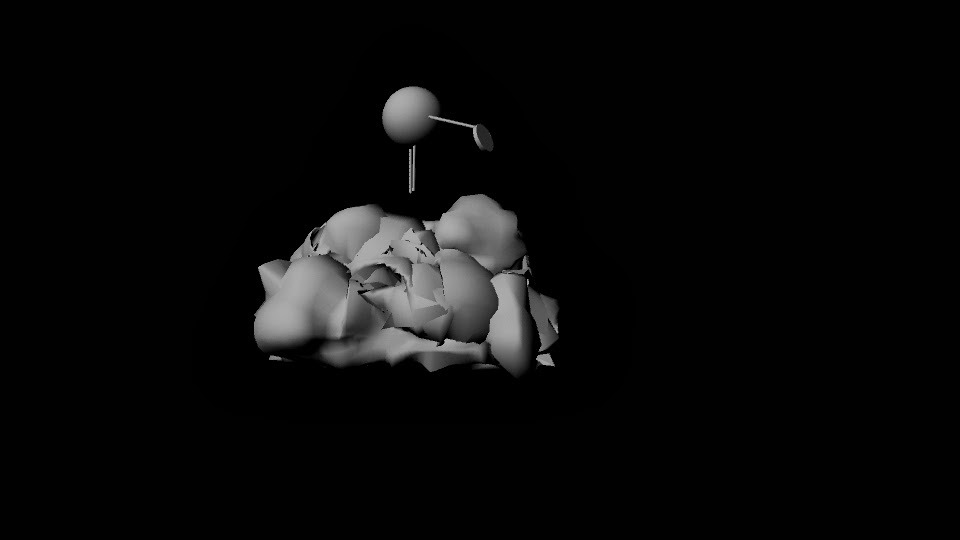
Digital Media 6.2 Assignment 3D rendering

Artist Statement
In this assignment I rendered in 3D a cartoon character I drew in high School. The name of the strip was "THE VOID"
The Void was in response to several events in my life that led me down a dark path in life. I used the character to create an escape for my feelings towards every day life. I used the strip to convey my feelings about politics religion and life in general
.  The void is a place in everyone's mind were we go to hide and heal ourselves from the public and stresses from ever day complications. The Void is a friend to all of us and is a good listener. This sculpture also represents my desire to take things apart both physically and mentally, it is our choice to put them back together or not. It represents my analytical side, for as we get more advanced we may represent complexity however we strive for simplicity.


Tuesday, November 5, 2013


Digital Media Artist Comparisons

     Since the creation of digital media as an art form the medium has split into different avenues of interests and developed many new forms of expressions from the same mother industry. I am looking at two forms of digital media and the artists that I found to represent their separate aspects of the medium. Looking through the list of artists I decided to look at digital media in the market place, and the interactive form of media expression. The two artists I have chosen are Katie Torn and Mike Hall.

From her bio, Katie Torn graduated from the Art institute of Chicago and lives in New York City. She is professor and an artist involved in the digital media medium. She has performed in live video exhibitions VIA Music and New Media Festival in Pittsburgh. She has a two-person show coming up this fall at Roots and Culture Contemporary Art Center in Chicago.

Her work is inspired from the roots of futurism and cubism. She uses up to date computer software similar to that used in Hollywood in film production to create her pieces of art. Her latest project called Dream House is a 3D animation of a “woman” biomorphic architectural structure. The animation structure slowly builds up with consumer products over a seven-hour period. The piece of art is a representation to the wants, desires, and waste caused by the modern market place. Katie walks in the area of hyperrealism with her prints and tries to use technology to focus the everyday routine of life in the industrial age.
 

******

From his Bio, Mike Hall is a video artist who operates out of his studio in Brooklyn, New York. His main body of work has been created from a unique form of light processes. “The process involves the creation of optical feedback reactions in which the form, color, reflectivity and texture of the projection surface causes the generation of imagery upon the surface itself”. The technical background of Hall's work based within a 20-year career in software engineering. One of his passions in life has been the lifelong study of music and how it has led to the development of his acoustically reactive software.

Currently he is finishing the development of a cloud-based web tool called media Frame, which features the ability to create “Complex, database-driven online media applications, written in a proprietary XML-based language”.

His work has required him to develop the specialized mechanical harnesses and staging elements which helps makeup this complex optical reaction. In addition to abstractions generated on uniform surfaces, Hall works with movement artists to interact with the optical fields, producing a luminous quality to the skin which suggests that the light is somehow emanating from the body in all directions.


The best way to compare these two artists is to say that Katie Torn uses her foundation in futurism and cubism along with the use of three dimensional programs to create an almost abstract form of hyperrealism, focusing on the industrial problems in consumerism.

Mike Hall Uses his knowledge of electronics and software, along with his fascination with light and sound to create images in an unique way. Using structures such as canvasses, walls he creates moving images that make patterns in a geometric form. His later work is involving the use of human subjects as his canvass, this provides an interaction with his audience by involving the sensation of emotion.

Citations